
Class 1: India vs Pakistan
How do two nations born from the same land become bitter rivals almost overnight? In this class, students will trace the dramatic Partition of British India in 1947 and examine how religion, migration, colonial borders, and nationalism reshaped South Asia forever. Students will investigate the disputed region of Kashmir, the importance of rivers and water access, and the constant tension created by nuclear weapons on both sides of the border. Through maps, simulations, and historical case studies, students will explore how geography, identity, and historical trauma continue to influence relations between India and Pakistan today.

Class 3: Israel vs Palestine
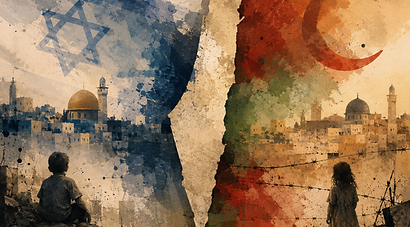
Why can one small strip of land hold such enormous religious, historical, and political significance? In this class, students will explore the Israeli–Palestinian conflict by examining competing national movements, sacred geography, refugee crises, border disputes, and security concerns that have shaped the region for generations. Students will investigate the historical roots of the conflict while also considering the modern challenges surrounding peace negotiations, settlements, and international involvement. Through maps, primary sources, and negotiation activities, students will grapple with one of the world’s most difficult and emotionally charged geopolitical conflicts.
Class 5: North Korea vs South Korea
Separated by one of the most heavily fortified borders on Earth, North and South Korea provide a fascinating case study in how ideology and political systems can dramatically shape societies. In this class, students will examine the legacy of the Korean War, the role of the Cold War in dividing the peninsula, and the vastly different paths the two nations have taken since then. Students will analyze propaganda, militarization, censorship, alliances, and daily life on both sides of the border while exploring the continuing tensions surrounding nuclear weapons and regional security. The class will also investigate how geography and global politics continue to influence the Korean Peninsula today.

Class 2: Russia vs Ukraine
Few modern conflicts reveal the power of geography more clearly than the war between Russia and Ukraine. In this class, students will examine how open plains, harsh winters, strategic ports, and fears of invasion have shaped Russian and Ukrainian history for centuries. Students will study the fall of the Soviet Union, the expansion of NATO, the annexation of Crimea, and the strategic importance of the Black Sea region. Using military maps, alliance simulations, and geopolitical analysis, students will investigate why this conflict matters not only to Eastern Europe, but to the balance of power across the world.

Class 4: United States vs China
As China rises economically and technologically, many experts believe the world is entering a new era of superpower competition. In this class, students will investigate the growing rivalry between the United States and China through the lenses of trade, artificial intelligence, manufacturing, naval power, cyberwarfare, and global influence. Students will explore why Taiwan and semiconductors have become so strategically important, how supply chains connect the world economy, and why control of major shipping routes matters so deeply. Through simulations and strategic challenges, students will examine the opportunities and risks created when two global powers compete for influence.

Class 6: Iran vs Saudi Arabia
Although Iran and Saudi Arabia rarely fight each other directly, their rivalry has influenced conflicts across the Middle East for decades. In this class, students will explore how religion, oil, geography, alliances, and political ambition shape the struggle for regional influence between these two powerful nations. Students will investigate the Sunni–Shia divide, the importance of strategic waterways and energy resources, and the role of proxy wars in places such as Yemen and Syria. Through maps, simulations, and geopolitical case studies, students will discover how competition between regional powers can reshape entire regions and affect the global economy.
